The Upcycling Revolution — and Why It Matters
A new generation of designers is changing how we see materials, and redefining what waste can become.

Upcycling has become one of the most compelling forces in contemporary design, not because it’s trendy, but because it’s transformative. At its core, upcycling is the art of seeing potential where most people see waste. It asks us to look at a discarded object and imagine not what it was, but what it could become. A soft fabric might be reworked into something sturdy; a rigid material might be broken down and reborn as something unexpectedly delicate. This mindset shift and this curiosity lie at the heart of innovation.
What makes upcycling exciting is not only its sustainability, but its uniqueness. When something is upcycled, it becomes one-of-a-kind: a piece nobody else owns, shaped by both material history and human imagination. In a world saturated with mass production, individuality has gained in value. Upcycling pushes us to question why we should settle for objects that are identical to everyone else’s when we can create, or support creators who make things that tell a story.
Integrating upcycling into our daily lives doesn’t require expertise. It simply requires consciousness. Paying attention to what already exists around us, experimenting, learning how to repair or reshape, and redefining waste as possibility. Upcycling is an invitation to slow down, to create, and to form a deeper, more responsible relationship with the things we use.
Across the world, designers are championing this movement, transforming overlooked materials into innovative fashion, products art or furniture proving that creativity and sustainability are not mutually exclusive - they amplify one another. Meet our Top 10 Favourite Designers Pioneering the Way of Upcycling
SAMUEL AGUIRRE — Reinventing Natural Fibers Through Circular Craft
Artist and furniture maker Samuel Aguirre crafts sculptural objects from natural fibers, exploring how ancestral techniques can inform sustainable contemporary design. Guided by circular principles, Aguirre rethinks conventional processes, developing new methods of structure, surface, and texture. By revisiting pre-industrial craft and bringing it into dialogue with modern forms, he demonstrates that sustainability is not about scarcity but ingenuity, and that tradition, when reinterpreted, offers pathways to a more ethical material future. One notable work is the Chair 03 series, crafted from mulberry-bush fiber. Discover more of their work via Instagram

UGO PAULON — Upcycling Vintage Footwear into Avant-Garde Shoes
Ugo Paulon is a purpose-led footwear project built entirely on pre-existing materials, proving that limitation is a powerful catalyst for creativity. Beginning with vintage shoes sourced from eBay, the brand embraces a reversed design process reminiscent of objet trouvé, letting found materials dictate form and aesthetic. Their signature spiral (appearing in prints and even reinterpreted as a sculptural trim) symbolises inward reflection, growth, and the rediscovery of forgotten resources. By working solely with deadstock and repurposed materials, Ugo Paulon reimagines footwear with a philosophy that merges innovation, restraint, and environmental responsibility. Discover more of their work via Instagram

RICCARDO CENEDELLA — Experimenting with Waste to Create Bespoke Furniture
Italian designer Riccardo Cenedella merges material research with craftsmanship to transform undesirable waste into functional, hand-crafted furniture. His approach is rooted in experimentation: testing how discarded matter can be reworked, reshaped, and revalued. For Cenedella, narrative and process take precedence, with form emerging as a result of deep investigation rather than aesthetic trends. His work, exhibited globally, acts as a critique of overconsumption while offering a hopeful vision of how materials can be endlessly reconsidered. Through high-end yet low-tech techniques, he demonstrates that waste is not a limitation, but a resource for innovation such as his works with upcycled Murano glass. Discover more of their work via Instagram

RUA CARLOTA — Transforming Pre-Loved Clothing Through Deconstruction & Knit Experimentation
Founded by Charlotte Rose Kirkham, Rua Carlota gives new life to forgotten garments by deconstructing and reconstructing pre-loved materials with an artist’s intuition. Rooted in experimentation, the brand challenges predictable ideas of sustainable fashion by treating fabrics as a painter treats a palette - stitching becomes the brushstroke, and shape becomes geometry in motion. Influenced by mathematics, portraiture, and the energy of knitwear pioneers like Stephen Burrows, Rua Carlota creates one-of-a-kind pieces that cannot be replicated. Each garment carries the imprint of Charlotte’s curiosity, offering wearers a unique, expressive alternative to
mass-produced design. Discover more of their work via Instagram

LUCAS MUÑOZ — Repurposing Construction Materials into Functional Sculpture
Spanish designer Lucas Muñoz transforms construction materials, industrial scraps, and everyday tools into furniture, lighting, and hybrid objects that challenge traditional categories. His work merges craftsmanship with conceptual inquiry, exploring how materiality shapes meaning and how reclaimed components can generate entirely new functions. By elevating objects once considered mundane or obsolete, Muñoz creates a dialogue between form, utility, and the environment. His award-winning practice highlights how sustainability emerges not only from material reuse, but from questioning the assumptions tied to the objects we live with. Discover more of their work via Instagram

FAÇON JACMIN — Elevating Vintage Denim into Architectural Garments
Façon Jacmin’s upcycled collections breathe new life into vintage denim through a meticulous process of cleaning, unstitching, reconstructing, and reimagining. Led by Alexandra Jacmin and twin sister Ségolène Jacmin, the Antwerp-based label transforms second-hand textiles into refined, sculptural pieces that blur the line between upcycled and new. Every irregularity in the material becomes part of the garment’s identity, reinforcing the brand’s commitment to transparency and circularity. Façon Jacmin’s work honours the durability and cultural significance of denim while pushing the boundaries of what discarded textiles can become. Discover more of their work via Instagram

EHÉCATL — Reworking Discarded Window Glass into Poetic Lighting Objects
Ehécatl’s practice turns old window glass into luminous sculptural pieces that explore renewal, material memory, and the beauty embedded in overlooked resources. Their Madreperla lamp exemplifies this approach: a delicate interplay of biophilic design, recycled glass, and atmospheric light. By giving architectural remnants a second life, Ehécatl engages with themes of rebirth and ecological consciousness. Each creation invites viewers to see discarded materials not as waste, but as vessels of hidden stories, encouraging a deeper connection with the resources that surround us. Discover more of their work via Instagram

LES FLEURS STUDIO — Reviving 19th–20th Century European Textiles
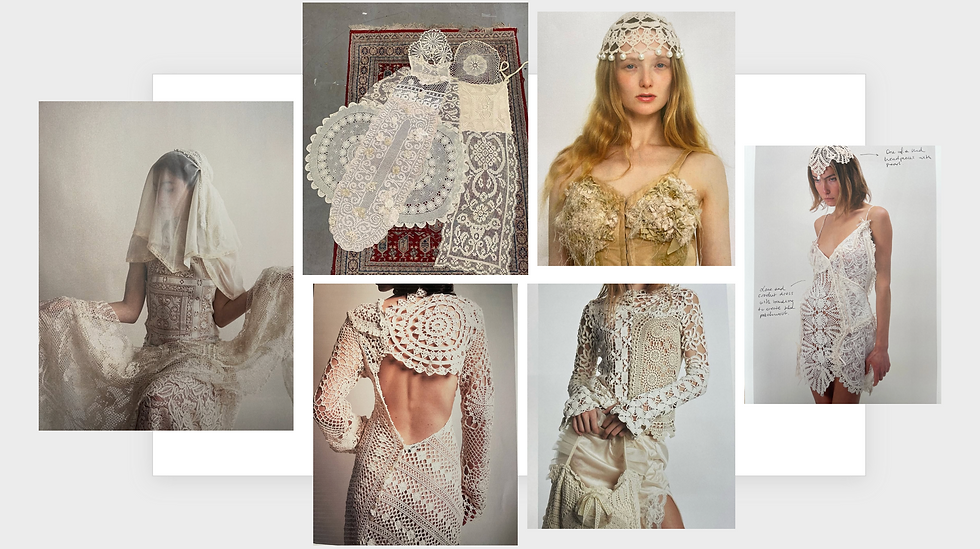
Founded by María Bernad in Paris, Les Fleurs Studio operates with a zero-waste ethos, crafting garments from vintage European textiles that carry decades of history. By working with limited and often rare materials, the studio creates intentional, one-off pieces that honour craftsmanship while reducing the environmental toll of new textile production. Mostly known for their delicate yet intricate hand-crocheted and lace garments and accessories, Les Fleurs opens up a whole new perspective on bridal wear. Every garment is sewn in-house, merging heritage fabric with contemporary sensibility. Les Fleurs Studio stands out for its ability to weave storytelling into each piece, breathing new life into discarded linens, embroideries, and woven relics while shaping a future where fashion respects both memory and material. Discover more of their work via Instagram
1/OFF PARIS — Reimagining High-End Vintage from YSL, Chanel & More
1/OFF Paris transforms high-end vintage garments into contemporary fashion statements, celebrating the legacy of designers like Chanel, Burberry, and Ralph Lauren through imaginative remake techniques. Founded by Renée van Wijngaarden, the brand rejects disposability and champions an eternal fashion cycle where creativity replaces overproduction. Each piece is curated, recut, and reconstructed by couture makers, resulting in unexpected silhouettes that connect past craftsmanship with future innovation. With a vision rooted in circularity, 1/OFF encourages the industry to rethink waste, embrace co-creative design, and build a fashion culture where nothing is ever truly lost—only transformed. Discover more of their work via Instagram

RAVE RVW — Turning Home Textiles into High-Fashion Statements
Stockholm-based Rave Review challenges conventional luxury fashion by transforming vintage home textiles such as bed linens, blankets, plaids, into runway-worthy garments. Founded by Josephine Bergqvist and Livia Schück, the brand proves that sustainable design can be bold, provocative, and unmistakably high-fashion. Their numbered, limited-edition approach ensures every piece remains unique, while their signature coats crafted from vintage blankets have become icons of upcycled couture. With collections featured at Gucci Fest and beyond, Rave Review leads the charge toward a future where existing materials are not only reused, but celebrated. Discover more of their work via Instagram

Upcycling is no longer just a creative detour or an eco-friendly alternative, it has become a cultural shift driven by designers who refuse to see materials as fixed or finite. The ten pioneers highlighted in this article show us that transformation begins with perspective: the willingness to question value, to imagine beyond function, and to treat waste as a starting point rather than an afterthought.
Their work proves that innovation and responsibility can coexist beautifully. And in a world overwhelmed by excess, upcycling offers not only smarter solutions but more meaningful ones, objects with stories, textures with history, and materials reborn with purpose.
As these designers continue to reframe how we create and consume, they invite us to do the same in our own lives. Upcycling isn’t just a movement within design; it’s an invitation to rethink our relationship with the things we own, the resources we use, and the future we’re shaping.
The next era of creativity isn’t built from the new - it’s built from everything we’ve overlooked.


Comments